



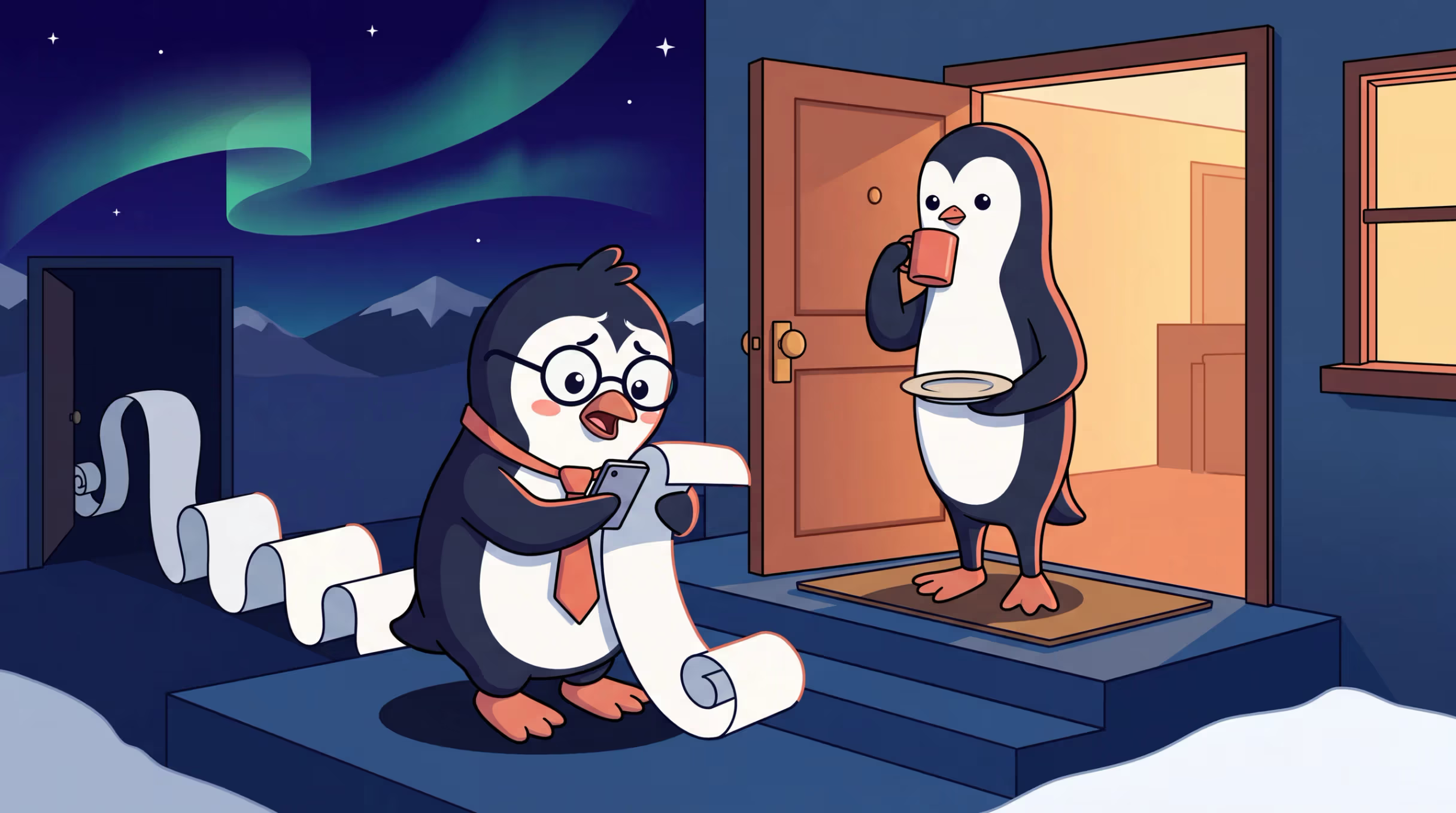
It’s Thursday morning. You have been staring at this message from Maya since Sunday night: “Dinner at mine Friday? Usual crew, I’m doing the big lasagna.”
Under it, in very small grey letters, it says “Read Sun 8:12 PM,” and you know Maya can see that too. Each day you wait, the reply in your head gets longer, because now it has to explain your no and the four days of silence.
You can answer Maya in two sentences: thank her for asking and tell her plainly that you won’t be there. A reason is optional, and the four days of silence need about four words of apology.
For a simple invitation with no late reply to account for, the whole message can be this:
Thanks for inviting me. I won’t be joining you on Friday, but I hope you have a lovely evening.

If your own draft is three times that length, the four passes below show which parts are doing the damage, one fix at a time.
What does overexplaining a no look like?
You type “Hey!!” for the fourth time, delete one exclamation mark, then put it back. Halfway through a sentence about how awful you feel, you realise your typing dots might be showing on Maya’s end.
The phone goes face-down on the duvet.
Your first draft, on Sunday at 8:15 PM, three minutes after opening her message, was a single sentence:
I’ve had such a busy week, and there’s laundry everywhere, and I might need to help my sister, so I’m not sure dinner is a good idea.
That one sentence holds three reasons and a maybe. It felt thin, so you kept adding, and by now the laundry has shown up in more of your declines than it has been folded.
By Thursday, the draft in your notes app has bloated into this:
Hey!! So sorry I’m only replying now, this week got away from me. I’ve had such a busy week, and there’s laundry everywhere, and I might need to help my sister, so I’m not sure dinner is a good idea. I feel awful because I know you’ve been planning this, and I’ll definitely come to the next one!! Sorry again.
Sixty words, and Maya still can’t tell whether to set a plate for you. She’ll also feel she has to reassure you before she can reply to anything else.
How do you say no to an invitation clearly?
Picture Maya on Friday afternoon, counting plates.
“I’m not sure dinner is a good idea” leaves one of them in limbo, and she may set it out anyway in case you change your mind.
Pass 1: Turn a maybe into a yes/no answer. Swap the hedge for a plain no with the day in it.
Hey!! So sorry I’m only replying now, this week got away from me. I’ve had such a busy week, and there’s laundry everywhere, and I might need to help my sister, so I won’t make it to dinner on Friday. I feel awful because I know you’ve been planning this, and I’ll definitely come to the next one!! Sorry again.
A clear answer is the kindest part of a decline, because it lets the host plan. Even if the evening doesn’t interest you, a definite no spares Maya a “so are you coming?” text tonight.
Do you have to give a reason for declining an invitation?
According to Mayo Clinic’s guide to assertiveness, your no should be direct and your explanation brief, when one is appropriate.1 Your draft has three explanations, and one of them is a guess.
Pass 2: Remove the alibi. The busy week, the laundry and the sister all come out.

The sister line was the riskiest of the three. A maybe-reason invites a workaround, and Maya is a problem solver who owns a large oven.
Every reason you add is a door. “I might need to help my sister” is one Maya can walk straight through with “Oh, just come after!”
Hey!! So sorry I’m only replying now, this week got away from me. I won’t make it to dinner on Friday. I feel awful because I know you’ve been planning this, and I’ll definitely come to the next one!! Sorry again.
For a casual invitation, you have a few honest ways to handle the reason:
- No reason needed at all. “I’m going to pass this time” is a complete answer to a casual invitation, and it doesn’t need a footnote.
- One true reason in a clause. “I’m staying home for a quiet evening” tells Maya enough without a tour of your week.
- A private reason, kept private. A family row, money troubles or exhaustion can stay off the page entirely.
Example message when you want a quiet night:
Thanks for asking. I’m staying home for a quiet evening tonight, so I’ll pass. Have fun.
Example message when you’d rather not discuss the reason:
Thanks for thinking of me. I’m going to pass this time, but I appreciate the invitation.
If the honest reason is that you’ve been saying yes too often and need your evenings back, that’s a bigger conversation than one text. Explaining to someone that you need some time alone walks you through it.
How do you decline an invitation without sounding rude?
In a series of five experiments with over 2,000 participants, people turning down social invitations overestimated how negatively the person who invited them would react.2
That can’t predict exactly how Maya will feel. It does suggest the guilt in your draft is bigger than anything she’s feeling.
Pass 3: Short apology, and thanks where the guilt was. “So sorry I’m only replying now, this week got away from me” becomes “Sorry for the slow reply.” The “I feel awful” line becomes a thank you at the start and a warm line about her evening at the end.
Sorry for the slow reply, and thanks for inviting me. I won’t make it to dinner on Friday, but I hope you have a lovely evening. I’ll definitely come to the next one.
“I feel awful” looks humble, yet it gives Maya a chore. She has to type “Don’t feel awful!! It’s totally fine” before she can get back to her lunch.
You’ve also spent longer on this text than she’ll spend layering the lasagna. The apology doesn’t need to show all that effort.
You don’t have to praise the dinner to acknowledge that she thought of you. If it were her birthday, the warm line could be about her:
Thanks for including me. I won’t be at dinner on Saturday, but I hope you have a brilliant birthday. I’m glad we’re friends.
Keep that last line only if it sounds like you, since a plain birthday wish works just as well. Leave out anything that asks her to confirm she isn’t disappointed.
Should you suggest another time when you turn down plans?
“I’ll definitely come to the next one” is the promise that comes back in March, when lasagna night rolls around and you’d rather stay home again. Guilt wrote that sentence, and you’re the one stuck keeping it.
Pass 4: Only offer what you really want. For Maya’s dinner, the promise simply goes, and the message ends on her evening.
If the group dinner is what doesn’t suit you and it’s Maya you miss, swap the vague promise for one small, specific plan:
Thanks for inviting me. I’ll pass on the group dinner, but I’d like to catch up with you. Would coffee on Sunday morning work?
Skip the coffee if it’s only there as payment for missing dinner. If she says yes, send a time and place yourself. If she doesn’t take it up, let it go.
For a friend you’d like to see more often, suggesting regular plans does more than any “next time.”
Side by side, the four passes and Maya’s likely reaction to each look like this:
Each rewrite fixes one thing (reactions are illustrative)
| Version | What changed | How Maya probably reads it |
|---|---|---|
| Sunday draft | Nothing yet | Unsure if you’re coming, and already typing “Don’t feel awful!!” |
| Pass 1 | The maybe became “I won’t make it to dinner on Friday” | Still noisy, but now she can count plates. |
| Pass 2 | The busy week, laundry and sister were cut | Nothing left to solve, so no “just come after!” |
| Pass 3 | One short apology, with thanks and a warm close in place of the guilt | Warm and settled. “Have fun!!” is the likely reply. |
| Pass 4 | The “next one” promise was cut | Just as warm, and nobody is keeping score for March. |
What do you say when someone keeps pushing after you decline?
Friday, 6:40 PM, your phone lights up on the couch: “Could you just come for an hour?”
An assertiveness handout from American University recommends repeating your original refusal, with no fresh reasons attached.3 Maya may just be hopeful, and a follow-up question isn’t always pressure. If your answer is settled, it can stay settled in a few words.

Maya: Could you just come for an hour?
You: Thanks, but I’m still going to pass tonight. I hope you all enjoy it.
If she asks why, you’re allowed to keep it to yourself:
I’d rather keep the reason private, but I won’t be coming.
Then send nothing else. The silence after a clear no feels huge from your side of the phone, and the urge to send a softening paragraph is strongest right there, after a message that was already kind.
If she asks a third and fourth time, responding when someone keeps pushing after you say no has lines for that.
When Maya replies to your no
She says “No worries, have a good one!”
Reply with a short “You too!” or a heart, then put the phone down. You're done.
She asks “Could you just come for an hour?”
Repeat your answer warmly in nearly the same words, with no new reason.
She asks “Aw, why? Everything okay?”
Give one honest sentence, or say you'd rather keep it private. Then stop typing.
She says yes to coffee on Sunday
Settle the details yourself today: a time and a place.
Nothing for a few hours
Leave it. She has your answer, and checking the read receipt every four minutes won't make her type faster.
Is canceling plans different from declining an invitation?
It could have been worse. Rewind to Sunday night in a different timeline, where you replied “Yes!! Count me in” at 8:13 PM with the confidence of someone who hadn’t looked at their week yet.
Backing out now carries more weight, because Maya may have arranged her evening around you.
When you cancel something you accepted, acknowledge the change and any inconvenience it causes. You can still be brief, as long as you recognize the plans she made. Say you’d agreed to a Thursday dinner, just the two of you:
I’m sorry to change our plans, but I need to cancel Thursday’s dinner. I know you arranged your evening around it. Could we try next Tuesday instead?
Offer another date only if you want to reschedule. The cost of a reserved table or tickets is a separate conversation, where you work out something fair together.
An invitation you never accepted usually doesn’t need that apology. If it’s a big occasion for the host, it’s courteous to respond by the date they asked for and show you care, without a detailed account of your circumstances.
If you’re declining more often because your weeks have changed, let your friend know that your availability has changed. It saves you writing this text every month.
What should a short decline text say?
At 11:02 AM on Thursday, the draft in your notes app has gone from 60 words to 26:
Sorry for the slow reply, and thanks for inviting me. I won’t make it to dinner on Friday, but I hope you have a lovely evening.
Read it over once. If it answers Maya and sounds like you, stop there, even though two sentences will feel strangely short after four days of drafting.
If you’d like to include one true reason, a single clause covers it:
Thanks for inviting me. I’m going to pass on dinner tonight and have an evening at home.
Practice your no before you send it

Open Quippy and rehearse your two-sentence decline, plus the moment your friend asks if you could just come for an hour.