




The worst offense against one’s diners in conversation is to launch into a long story. By the time you have managed to explain where you were staying that year, and you are three sentences into your tale of the wonderful time you had, others have enough insight into their own hunger to be reaching for the bread. And when at last you arrive at the wonderful part of your tale, a polite “Huh” ensues.
Most of the fixes for these types of long stories to tell have to do with order and length. First, choose a story to tell and try to make it relevant to the current conversation. Then introduce the story with a hook and close the story with a comment on how the story ended. Within the body of the story try to keep a linear development and stick to one thread or story line. Work backwards from the end of the story. Try to include only the information that the ending of the story needs to make sense. Within each section, try to keep to the minimum amount of information that will help the listeners to follow the story. The different sections below will go through each part of the story to be told one section at a time and give examples of what it would look like.
Pick a story that connects to the current topic
You have a greater chance of telling a good story at dinner if the story in question already connects to something that’s already been discussed by the group. For example, your airport story about the worst flight of your life is immediately relevant if the current topic of conversation is complaints about airports. But a good story about your cousin’s wedding would require you to start to tell that story and explain why you’re telling it and add more to what’s already been discussed.
Before you start, ask yourself what the last two minutes of conversation were about. Link to that in a few words (e.g. “That reminds me of the worst flight I’ve ever been on.”)
This will give the group context for why you are sharing this story in the first place. If nothing you have fits into the conversation then save this story for later and ask a related question.
Start with the hook
We all have started a story at dinner and three sentences in, we are still explaining where we lived in that year and the story is still evolving. By the time we finally get to the good part, people are reaching for their bread, until finally the ending arrives and people go “huh” in polite surprise.
Shorten the setup to only include information necessary for the listener to understand the ending of the story. Open with a short label for what happened, which enables the listener to anticipate what will happen next in the story.
Now the setup has a role to play. Every detail, whether it be a description of a place, person, or thing, will lead up to the story’s ending and that horrible haircut of yours.
The hook for a personal story of why a certain story was significant to you to tell would be “It was the day I learned my dad can’t read a map.” Thus listeners know what to listen for in the story.
Cut the setup to what the ending needs
Start from the end and ask yourself what did the listener need to know in order for the ending to make sense. Cut everything else. If the punchline depends on your barber being your neighbor then mention that at the start of the story. You can cut the year and the weather.
Working your way backwards from the ending, you can simply ask the question: Is this necessary to the ending? If the answer is no, cut it.
Keep one thread and build to the turn
Most detours can be told as another full story, and therefore it is best to leave them out in the first place. Any side detail that starts to grab your attention in the body of your story should be jettisoned. You can tell the story of that anecdote later. If you do go off on a side detail, a simple “Anyway, back to the barber” note will keep your listeners on track.
Most stories change direction once during the telling of them, and that is the point at which you say the turning point of the story in the simplest of terms. For example, in the story about getting the worst haircut of my life and having to pay extra for it, the turning point is when the barber picks up the clippers.
I got the worst haircut of my life, and I paid extra for it. The barber was my neighbor, so I said, 'Do whatever you think.' He . Anyway, I wore a hat for three weeks.
This is the turn. Everything before it is setup the ending needs: the hook, the neighbor and the 'do whatever you think' line. It is said in short, plain words, and the story ends one sentence later.
Land the ending and stop
After the turn, deliver a single closing line that describes how things ended, and then stop talking. The natural reaction to the story is then given, or else an opportunity to ask a question is granted to others.
Do not elaborate on how something was funny and try to avoid re-telling the punchline of your story. If the reaction to your story is quiet, one short closing statement will still make a good ending.
Watch your listeners and trim as you go
Even a good story can run too long for a particular audience. Pay attention to their interest in hearing the rest of your story and make sure to give them the ending as soon as possible. If they start to drift off (eyes drifting to a phone or across the room, replies shrinking to a short “mm,” or someone angling toward another conversation), jump ahead to the punchline and set up a bridge to continue.
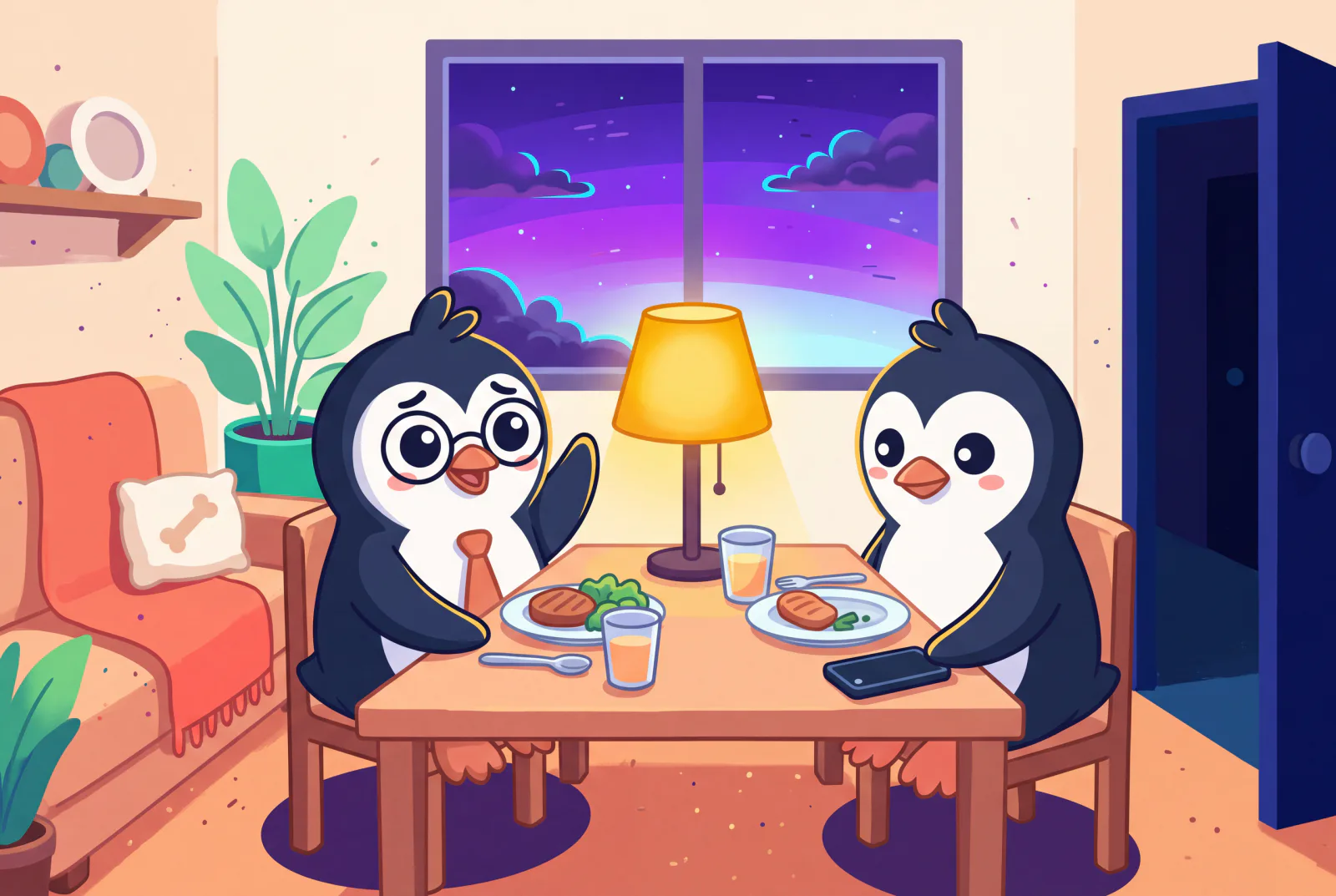
- Eyes on the phone
Jordan's gaze has drifted to the phone by the plate. One glance means little, but repeated glances suggest skipping ahead to the turn.
- Body angled away
Jordan is sitting back from the table instead of leaning in. A listener who leans away is often ready for the ending.
- Still in the setup
Sam's flipper is raised mid-explanation, and the turn hasn't arrived yet. This is the moment for a bridge line like 'Long story short...'
How can you possibly read the signs? Research on conversations suggests people are poor at it. A study of 932 conversations, drawn from an online survey of adults about a recent conversation with a romantic partner, friend or family member plus a lab study pairing 252 strangers with each other, found that people’s best guess as to when their partner wanted to stop talking was “highly inaccurate”1.
That study, on the other hand, looked at whole conversations and did not study stories. And its survey data, which was the larger of the two datasets, relied on one person’s recollection of the conversation. So take its findings with a grain of salt. But the upshot is that, as with so many things in life, it’s wise to err on the side of caution and shoot for short. Just give them a way in, and see if they want to take it the rest of the way.
Tell the ending more quickly, using a transition as needed.
Then proceed directly to the turn and the conclusion of your story.
Hand the floor back
A good way to end a story is to give the other people a chance to tell a version of the same story. End your story with a question to your listeners, i.e. ask for their own version.
If one person seems like they have a story that they want to tell to join in here, you can always do a last second hand-off to that person. In other words, you can invite them by name:
The end of your story can open up more discussion too. Try finishing it off and then asking if the other person has had a similar situation occur in their life.
A short story that hands the floor back (illustrative)
 Sam
SamI got the worst haircut of my life, and I paid extra for it.
 Jordan
Oh no. What happened?
- Sam
My neighbor cut it. I said do whatever you think, and he shaved a stripe right down the middle. I wore a hat for three weeks. Has anyone else had one go that wrong?
- Jordan
Yes. In Lisbon I asked for a trim and walked out with a bowl cut.
- Sam
A bowl cut? How long did that take to grow out?
Practice one story this week
Find a story you already tell often and write down the hook (introduction) in one sentence. Then list the key elements your listeners need to hear for the ending. Cross out the rest of the details and practice telling it in less than one minute, ending with a question for them to answer.
Tell one story in under a minute

Say your hook in one sentence, go straight to the turn, give one closing line, then ask a question that invites someone else's version. Start the timer and stop talking before it ends.
Practice telling this one short story in a conversation this week. If you want a low-stakes place to rehearse, go to Quippy and have a conversation with a scene partner in Quippy before your next dinner with your friends and family. Then practice telling this short conversational story out loud to your scene partner.
Sources and references
- Mastroianni, Gilbert, Cooney & Wilson (2021). Do conversations end when people want them to? Proceedings of the National Academy of Sciences.932 conversations: an online survey of US adults about a recent conversation with an intimate, plus 252 lab participants paired with strangers; measured wanted versus actual conversation length and guesses about the partner's wishes; it studies whole conversations, not stories, and Study 1 relied on one side's report.